Wednesday, December 15, 2010

Online WikiLeaks game is a hit


Inception [Blu-ray]Transcend 4 GB Class 6 SDHC Flash Memory Card TS4GSDHC6EWestern Digital WD Elements 2 TB USB 2.0 Desktop External Hard Drive WDBAAU0020HBK-NESN       

A computer-game parody of the much-talked-about WikiLeaks saga has made a splash online.
In the online game, players assume the role of WikiLeaks founder and outsized personality Julian Assange hiding behind President Obama's desk in the Oval Office.
Using their mouse, players must manipulate the Assange character to smuggle secret documents from Obama's laptop onto a USB drive as the president dozes off. Those who fail are treated to a juicy presidential sound bite and a mock story planted in the newspaper.
More than a million people have visited the website for "WikiLeaks: The Game" since it was posted five days ago, developer Sebastiaan Moeys, 21, told ABC News.
"Just like governmental attempts to quash WikiLeaks, the game is harder than it looks," wrote Alexia Tsotsis on the tech-news blog TechCrunch. "I've played it five times and I still haven't won."
Game developers have been quick in recent years to capitalize on the popularity of prominent news events.
Satirical animated games have spoofed Tiger Woods' extramarital scandal, the Hudson River plane landing, the Chilean mine rescueand the rescue of a ship captain from Somali pirates.

By following his website:

Tuesday, November 16, 2010

Long 'Harry Potter' movie clip leaked online

c
an't wait until Friday to check out the latest installment of the "Harry Potter" film series? Well, if you have any knowledge of torrent sites at all, you should be able to view the first 36 minutes today, as a goodly chunk of the film has leaked online.
The leak comes one day after the New York City premiere of the film.
According to TorrentFreak, the beginning of "Harry Potter and the Deathly Hallows" (the first installment of the two-part finale) is currently available on dozens of torrent sites. A quick search by the staff of Mashable proved this to be true.
This news is sure to cause a frenzy among Potter fans -- TorrentFreak reports that "Harry Potter and the Half-Blood Prince" scored a spot on its "most pirated movies" list with nearly 8 million downloads last year.
The book version of "Deathly Hallows" also leaked -- back in 2007.
So why is the cinematic leak only 36 minutes long? TorrentFreak postulates that Warner Bros. Pictures feared a leak, so it limited the time of the screeners to ensure that the whole film didn't make it to the web.
Seeing as how the clip has hit the internet mere days before the premiere, we doubt it will have a negative effect on box office sales come Friday -- unless, of course, those first 36 minutes are irrevocably horrible.
The last time we saw a leak of this magnitude was probably that of "Wolverine," which leaked a month early last year yet was still a box office success.
What effect do you think the "Potter" leak will have on opening night?

Saturday, November 13, 2010

Intel raises its dividend

chart_ws_stock_intelcorporation.top.png By Aaron Smith, staff writer


NEW YORK (CNNMoney.com) -- Intel Corp. announced Friday that it is raising its dividend by 15%, joining the ranks of other technology giants that have beefed up dividend activity.
Intel said the increase pushes its quarterly cash dividend up to 18 cents per share, or 72 cents per share on an annual basis.

"Our ongoing operational performance and confidence in our business going forward provide the ability to return more cash to shareholders," Chief Executive Paul Otellini said, referring to 2010 as Intel's "best year ever."
The move boosts the chipmaker's dividend yield to 3.4%, based on the company's Thursday closing price of $21.21 per share. That exceeds the yields offered by bonds such as the 10-year note, which was at 2.7% on Friday.
The company has been paying a cash dividend since 1992, and said it has already doled out $2.6 billion in dividends in the first three quarters of this year.
Intel's (INTC, Fortune 500) stock rose more than 2% on the news.
This is the latest example of a ramp-up in dividend activity as corporations look for ways to generate shareholder returns on their fattened wallets.
Intel is following in the footsteps of Microsoft Corp (MSFT, Fortune 500)., which ramped up its dividend in September for the first time in two years. The software company increased its quarterly dividend by 3 cents to 16 cents per share.

GOOG-411 shuts down, but there's an alternative

                                                                                                                                              Google's 411 service will shut down for good on Friday, but that doesn't mean the end of free calls to business numbers.
Launched in 2007, GOOG-411 was a free voice recognition search service for business listings drawn from the Google Local directory. You'd dial 800-GOOG-411 (or 877-GOOG-411), speak a search request (business name or category) into your phone, and Google would list results in audio.
When you selected a result, Google would place the call -- which meant if the number was long-distance, the call would be free to you.
According to PhoneNews, some cost-conscious callers would call GOOG-411 to place free calls to business numbers -- using it like a "friends and family number." I found this especially useful when calling tech support or customer service numbers -- which often, surprisingly, aren't toll-free.
But, even without the Google service, there's still another way to get around charges for calls to business numbers.
Microsoft's Bing suite of search tools offers a nearly identical service, called Bing 411. According to this audio demo, it works almost like placing a normal 411 call through your phone company -- only without the hefty charges most phone companies levy for this service.
PhoneNews notes it takes 24 hours to update friends-and-family numbers with your phone provider, so this service is useful when you unexpectedly need to call a long-distance business number

Monday, November 8, 2010

RockMelt browser is social, but not obnoxiously so


Is it worth switching to a new browser? Marc Andreessen never had to force users to ask that question when he built Mosaic in 1993. For most early adopters, it was their first browser.
But now he's backing the development of another browser, RockMelt. This browser is not perfect, but it does show that there's room yet in the market. If Facebook built a browser, it would probably look a lot like this.
This has been tried before. The other social Web browser, Flock, integrates Facebook features. Also, like Flock (at least the new 3.0 version), RockMelt is built from Chromium, the same Google-developed open toolkit underneath the Chrome browser.
RockMelt is solid effort and is worth trying. Here are some reasons you will probably like it; and, to be fair, some things that may turn you off:

RockMelt is called the "Facebook browser" for a good reason. It gives you two dashboard wings: the left-hand wing shows you which Facebook friends are online; the right lets you drill into your social services, RSS feeds, and plug-ins.
(Credit: Screenshot by Rafe Needleman/CNET)


Why you'll like it

It's a real social browser
RockMelt shows which of your friends are online on Facebook, right in your browser. If you want to share something from the Web, you'll know who's going to see it right away. It makes sharing links and pages more engaging than using Twitter or even Facebook's site. (Downside: you can't scroll the left-hand "Facebar," which is sorted alphabetically, so unless you filter your friends by your RockMelt favorites, you'll always see your "A" friends on your list but you may never see your "Zs.")

Yet the social aspect is not overwhelming
RockMelt puts your friends in a narrow bar on the left, and status badges for sites (Facebook and Twitter, plus RSS feeds and plug-ins) in a skinny bar along the right. On wide-screen and large monitors, these dashboards are at once informative and unobtrusive. The design works. Flock's social sidebar has the cool feature of pulling status updates from all your social networks into one stream, but it's more in your face than RockMelt's.
Sharing is fun and easy. So is updating
There's a "share" button near the URL entry field. You can share pages to Facebook or Twitter easily and intuitively. The same button lets you send links as private messages directly to specific Facebook users (but not as direct messages to Twitter friends.)
If this were a Facebook browser, by the way, it'd probably say "Like" instead on the Share button. Look for that change when Facebook buys out this company.
You can also send out Facebook and Twitter status updates without sharing anything. It's equally easy and fast, although the status update button is in a different part of the browser frame.
It has a really slick search function
RockMelt breaks with Chrome's single URL and search box concept and gives you an old-fashioned search field alongside, just like ye olde Firefox. When you search in the RockMelt field, you get a drop-down window with results that pre-cache into the background. As you cursor down the list, the page behind the window updates fast. Power browsers will appreciate a tiny but wonderful "add as tab" button in each result in the search window that opens a result in a new tab without changing your focus to it. Got a lot of results you want to visit later? Click, click, click. They're loaded into tabs that you can get to at your leisure.
You can still search in the URL field, as with Chrome, but RockMelt's search is better.
It's fast like Chrome
Although it appears to be a bit of a process hog, RockMelt is fast. There's no speed penalty for the social features.
It does RSS better than any other browser
If you're on a site with an RSS feed, a little icon lights up to let you know it. It's a snap to subscribe to the feed and add a site icon into your right-hand sidebar. RSS results display in a scrolling window, with previews. The RSS preview window doesn't have the same functionality as the search results window, however.
The beta has a great invitation system
During the beta period, when you go to the RockMelt site, you're asked to sign in with Facebook. If you request an invitation, your Facebook friends who are on RockMelt will see that you're awaiting access when they open up their browser. Any one of them can then hook you up. As a pal on Twitter said, "It makes the inviter and invitee feel special."

Still feels like a beta

RockMelt is still beta and it feels like it. Things you might want to think about before you dive in include the security and privacy issues of hitching a Facebook app so tightly to your browsing history. Also, RockMelt is not based on the most recent or safest build of Chromium.
It also looks like some of RockMelt's cloud-based services are overwhelmed at the moment. My social sidebars wouldn't load into RockMelt on a Windows machine after a restart of the browser, and the invitation system wouldn't find all my friends when I wanted it to.
And while Chrome plug-ins will load into RockMelt, I found some that didn't display their content correctly. RockMelt also needs a few more networking services layered into it (like LinkedIn, perhaps, or Gmail). But Facebook and Twitter are good starting points.
I don't know if I'll still be using RockMelt next week, but assuming the bugs get squashed in the product and that the company can reassure users about privacy, I can't see strong reasons to avoid this browser. It's fast, it's got a really great search feature, and while it is a social browser, it's subtle about it. It's well worth taking for a spin.

Friday, November 5, 2010

China's Hu tops Forbes 'most powerful' list

(CNN) -- Chinese President Hu Jintao has topped the list of Forbes magazine's list of the world's most powerful people, besting U.S. President Barack Obama who slipped to the second spot.
The magazine said it used four criteria to define power -- whether the person has influence over a lot of people; whether they have significant wealth compared to their peers; whether they are powerful in more than one sphere and whether they actively wield power.
In that respect, said the magazine, the editors picked Hu as the most powerful man in the world. The annual list was released Wednesday evening.
As the leader of China, Hu presides over 1.3 billion people -- one-fifth of the world's population, and over the world's largest army. Under him, China has become the world's second-largest economy. And, says Forbes, "Unlike Western counterparts, Hu can divert rivers, build cities, jail dissidents and censor Internet without meddling from pesky bureaucrats, courts."
Julian Assange, the editor of WikiLeaks, makes the list (No. 68), as does Facebook founder Mark Zuckerberg (No. 40). In addition, several accused criminals do too, including al Qaeda leader Osama bin Laden (No. 57).
The top 10 most powerful people, according to the magazine:
1. Hu Jintao, president of China
2. Barack Obama, president of the United States.
3. Abdullah bin Abdul Aziz al Saud, the king of Saudi Arabia
4. Vladimir Putin, the prime minister of Russia
5. Pope Benedict XVI
6. Angela Merkel, the chancellor of Germany
7. David Cameron, prime minister of the United Kingdom
8. Ben Bernanke, chairman of the Federal Reserve
9. Sonia Gandhi, president of the Indian National Congress
10. Bill Gates, founder of Microsoft and co-chair of the Bill and Melinda Gates Foundation.

Facebook knows when you'll break up


This chart tracks relationship trouble via Facebook status updates, which show a spike of breakups in the spring.


(CNN) -- Worried about when you might get dumped? Facebook knows.
That's according to a graphic making the rounds online that uses Facebook status updates to chart what time of year people are splitting up.
British journalist and graphic designer David McCandless, who specializes in showcasing data in visual ways, compiled the chart. He showed off the graphic at a TED conference last July in Oxford, England.
In the talk, McCandless said he and a colleague scraped 10,000 Facebook status updates for the phrases "breakup" and "broken up."
They found two big spikes on the calendar for breakups. The first was after Valentine's Day -- that holiday has a way of defining relationships, for better or worse -- and in the weeks leading up to spring break. Maybe spring fever makes people restless, or maybe college students just don't want to be tied down when they're partying in Cancun.
And let's hear it for cheapskates. The other big romantically treacherous time, according to the graph, is about two weeks before Christmas -- presumably as people begin pricing gifts for their significant others.
Mondays, as if they weren't bad enough, are the most likely day to break up. Summer and fall look like the safest seasons.
And, possibly showing that some people's sense of humor is more twisted than others, there's a spike in breakups on April Fool's Day.
What single day are you least likely to get a "Dear John (or Jane)" letter?
"Christmas Day," McCandless said. "Who would do that?"

Terror battle likely to top Obama agenda in India

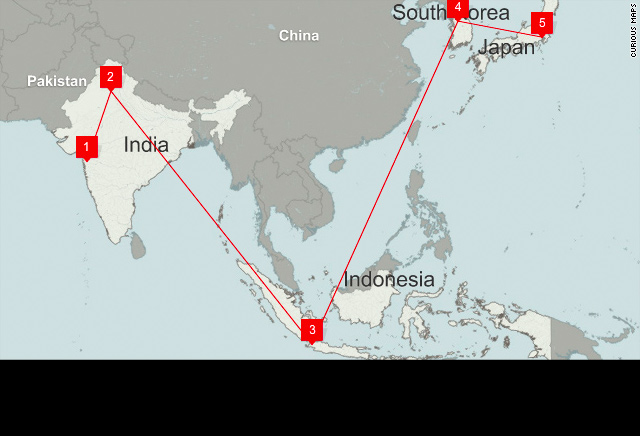
New Delhi, India (CNN) -- U.S. President Barack Obama's first stop in Asia will be India's financial hub of Mumbai, scene of the deadly terror attacks of November 2008 that left 164 people dead.
His planned commemoration of the terrorist attack during his first event there underlines the importance that the U.S. is placing on boosting collaboration in dealing with terrorism believed to be centered in the region across India's western borders, analysts say.
"Obama's Mumbai visit is symbolic of the perspective India and the United States share on terrorism. It should lead to strengthening of counterterrorism efforts," said V.P. Malik, India's former army chief.
The 2008 terror attacks, blamed on Pakistan-based militants, derailed a fragile peace process between New Delhi and Islamabad.
Under U.S. pressure, the two nuclear-capable states held talks this year in an attempt to resume their fully-fledged dialogue, but progress has been slow.
Apart from their bitter dispute over the Himalayan region of Kashmir, India and Pakistan have also been wary of each other's roles in Afghanistan.

Involved mainly in the reconstruction of Afghanistan, India suspects the Af-Pak terrain has become a platform for terror outfits of different shades to collaborate against New Delhi's interests.
After winning a non-permanent slot at the U.N. Security Council in October, India identified the "troubled neighborhood" to its west as a priority area to work on.
India believes a solution to the Afghan crisis lies in building strong democratic and security capabilities in the war-ravaged country.
"Gains of the last nine years stand to be squandered if this aspect does not receive the attention that it deserves as the international community ponders its next steps regarding Afghanistan," the external affairs minister, S.M. Krishna, said at a conference in Kabul in July.
Analysts see the United States and India diverging over Obama's Afghan policy, especially the administration's transition plans from July 2011.
"India's perspective is different and it's a longer-term perspective," said Malik. "An early exit of U.S. and allied troops from Afghanistan -- before democratic and military institutions are firmly in place -- would only lead to a new round of instability in that country."
Experts insist the U.S. can help quell entrenched suspicions that India and Pakistan have about each other over Afghanistan.
"Obama can make clear to [Indian Prime Minister Manmohan] Singh that Washington is not going to let Pakistan monopolize Afghanistan and that America wants India to be part of the process of stabilizing Afghanistan," Bruce Riedel, a senior fellow at the Brookings Institution, wrote in a column in the Times of India newspaper.
"At the same time, Washington needs to assure Pakistan that its interests in Afghanistan will be protected and that Afghanistan will not be a base for subversion. The United States can play the role of intermediary between Islamabad, New Delhi and Kabul to ensure a genuinely independent Afghanistan that is no one's satellite or sphere of influence," wrote Riedel, who chaired Obama's policy review of Afghanistan and Pakistan in 2009.
Obama's three-day visit to Asia's third largest economy and one of the world's few growth markets also includes meeting with Singh and other top leaders, and addressing the nation's parliament.
"The simple truth is that India's rise, and its strength and progress on the global stage, is deeply in the strategic interest of the United States," said William Burns, under-secretary at the U.S. State Department, during a briefing on U.S. President Barack Obama's upcoming tour of Mumbai and New Delhi.
Uday Bhaskar, director of the National Maritime Foundation in New Delhi, said Obama's tour holds the promise of broader cooperation.
"There indeed is such potential to tap, which goes well beyond the tenures of President Obama and Prime Minister Manmohan Singh," he said. "The real big-ticket issue which goes beyond the tenures of individual leaders would be India and the U.S. working jointly toward elimination of nuclear weapons and something as tectonic as commercial viability of solar energy."
Obama in India: Serious business
Obama's visit can also help balance regional geo-politics in the face of what is now seen as an increasingly assertive China, Bhaskar said.
The Chinese and Indian prime ministers met in October in a bid to ease growing tensions despite flourishing trade between the two neighbors.
China's support to Pakistan, India's accommodation of the exiled Tibetan leader, the Dalai Lama, and a decades-old border dispute between the two sides, are points of friction as the economic powerhouses jockey for influence in the region.
"Basically, a more enabled India would make the management of China in the regional grid more conducive to both the United States and India. This could be an objective of the upcoming Obama-Singh summit," Bhaskar said.
After India, Obama travels to Indonesia, then onto the G-20 meeting in South Korea and APEC (Asia-Pacific Economic Cooperation) in Japan.

Thursday, November 4, 2010

Google to enable remote security control for Android 2.2 devices

I have heard from lots of people that they are concerned about security on their Android devices, but it looks like Google is taking this concern seriously and will soon be offering a method for IT managers to have some control over Android devices in the workplace. The upcoming Google Apps Device Policy application will enable authorized company personnel to provide secure management and sync control over Android 2.2 devices. The great thing is that this device management can occur from within a web browser so no dedicated server is needed.
Some of the security functions that can be controlled include:
  • Remotely wipe all data from lost or stolen mobile devices
  • Lock idle devices after a period of inactivity
  • Require a device password on each phone
  • Set minimum lengths for more secure passwords
  • Require passwords to include letters and numbers
I use an HTC EVO 4G to access my company email, but that is managed and controlled through Exchange ActiveSync. Some future HTC devices will support this type of control through HTCSense.com, but that is very device and user specific. Do you use an Android device as your business phone?
Thanks to Android Arena for the heads-up.

Mobile Number Portability might finally launch on November 25th, or not

The elusive mobile number portability might finally roll out starting November 25th. Having said that if it were delayed  once more I wouldn’t be surprised. The Department of Telecommunication (DoT) said that the service will begin roll out in Harayana (in North India) on the 25th of November. The reason for the delay and three missed deadline is partly infrastructure and partly the lack of willingness from the service providers.
The roll out of the service will be done in phases with the 22 telecomm circles being divided into two geographical zones which are further divided to represent cities within the zones. Sachin Pilot (Minister of State for Communications and Information and Technology) said, “The MNP will make the mobile sector more competitive as companies will be forced to upgrade and improve their services leading to more benefits for customers in terms of both quality of service and its cost-effectiveness.” On the delay of the launch he sighted the rapid growth of the mobile sector and avoiding any technical glitches as reasons.
The service was expected to start on November 1st but was delayed to November 25th. COAI Director General Rajan S Mathews said, “All the intra-circles will be competed by November 30. Inter-circle for Haryana will also be completed. So the next phase is inter-circle, that is circle-to-circle. That will commence on December 1.” COAI Cellular Operators’ Association of India.
Adding confusion to the release date, there is news that the GSM operators have requested the government to push the delay across the country further to January, 2011. CDMA and the new GSM operators say they are ready to roll out the service. Mr S.C. Khanna from the Association of Unified Telecom Service Providers of India, said: “Only the incumbent GSM operators have an issue. All the CDMA and new GSM operators are ready to start MNP by December. DoT should go ahead with it.”
Airtel, Vodafone, Idea Cellular are said to  be the ones who’ve asked the government for the extension. The service not being started in the metros like Mumbai, Delhi, Bangalore seems to be a compromise reached to get the service rolling at the same time appeasing the big GSM players.